Self-initiated / Desktop and mobile / 2026

A brand visual language builder that writes down the few rules that make a brand look like itself, makes AI-generated artifacts inside them, and points at the one thing that is off.

- Type
- Self-initiated project
- Sector
- Creative tools, brand and marketing
- Platforms
- Desktop and mobile
- Services
- Strategy and research
- Product design
- Brand identity
- Design systems
- Development
The person and the agent
The agent reads the brand, generates, checks and proposes. The brand owner approves the rules and the exceptions. The marketer asks and approves. Nothing changes the language without a person.
A self-initiated project: no client, not launched, no users or results. Every person, company and figure in the screens is invented.
01 / Strategy and research
A brand looks like itself because of six behaviours, not fifty pages.
The problem
More of a brand’s everyday visuals now come out of generators. Guidelines were written for people to read once; generators get a kit (logo, hex values, fonts) or a style model trained on images. A kit lists ingredients but not behaviour. A style model copies a look but cannot tell you why a result is wrong. And models do not reliably keep exact values just because they are in a prompt.
What exists
Brand kits inside generators, trainable style models such as Adobe Firefly custom models, guideline portals, and “brand as code” platforms like brand.ai, the closest idea to ours. Our angle is narrower.
The insight
If a brand’s few behaviours are written so an agent can follow and check them, the useful output of a review is not a score. It is one sentence: the one thing that is off, and how to fix it.
Who does what
The agent reads the logo, past work and site, proposes rules with the evidence it found (“seen in 12 of 14 pieces”), generates artifacts, checks every rule and notices repeated fixes. The brand owner approves rules and decides exceptions. The marketer asks for an artifact and approves it. Every language change is a new version that can be rolled back.
Trade-offs
One named deviation instead of a score: you lose “how close”, you gain a decision that takes seconds. Six rules, not a full guideline. The agent proposes; it never edits the language itself. Mobile is ask-and-approve only; rules are built on desktop.

02 / Product design
An invented customer, and two people: the brand owner and the marketer.
To make it real we invented Noonday, a small mineral sun-care company with pine green, cream, a sun-yellow disc and lowercase serif headlines. Every artifact in the screens is composed by hand in Figma, so the brand on screen is theirs, not ours.
The UI rule, on one screen: one thing off
Know
The sun sits inside the frame.
Do
Fix it.
Eases
The evidence: Noonday crops the sun at an edge in 12 of 14 pieces.


Desktop, where the brand owner builds and governs the language / 6 screens
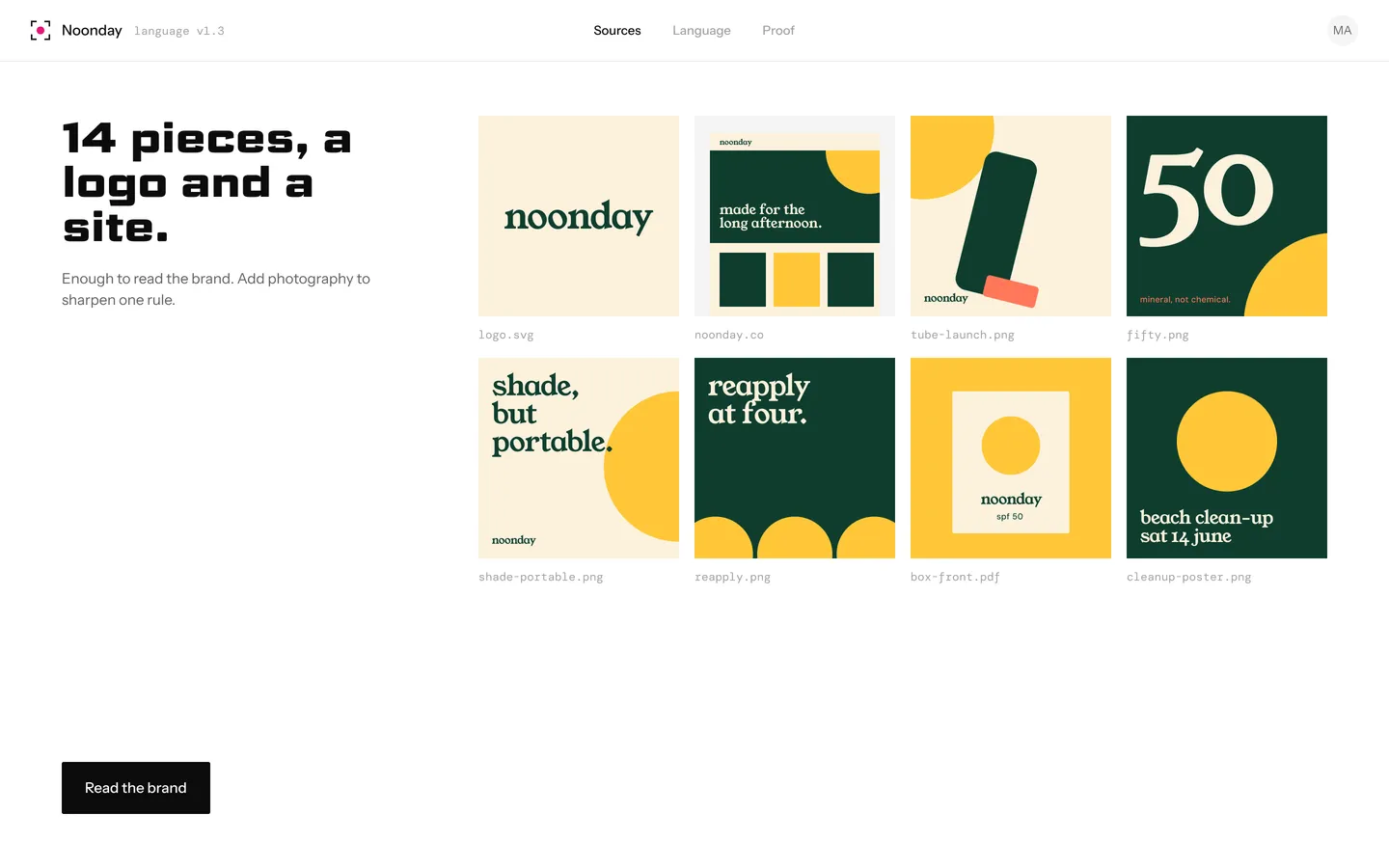
01 / 06
Sources
14 pieces, a logo and a site are in. One action: read the brand.
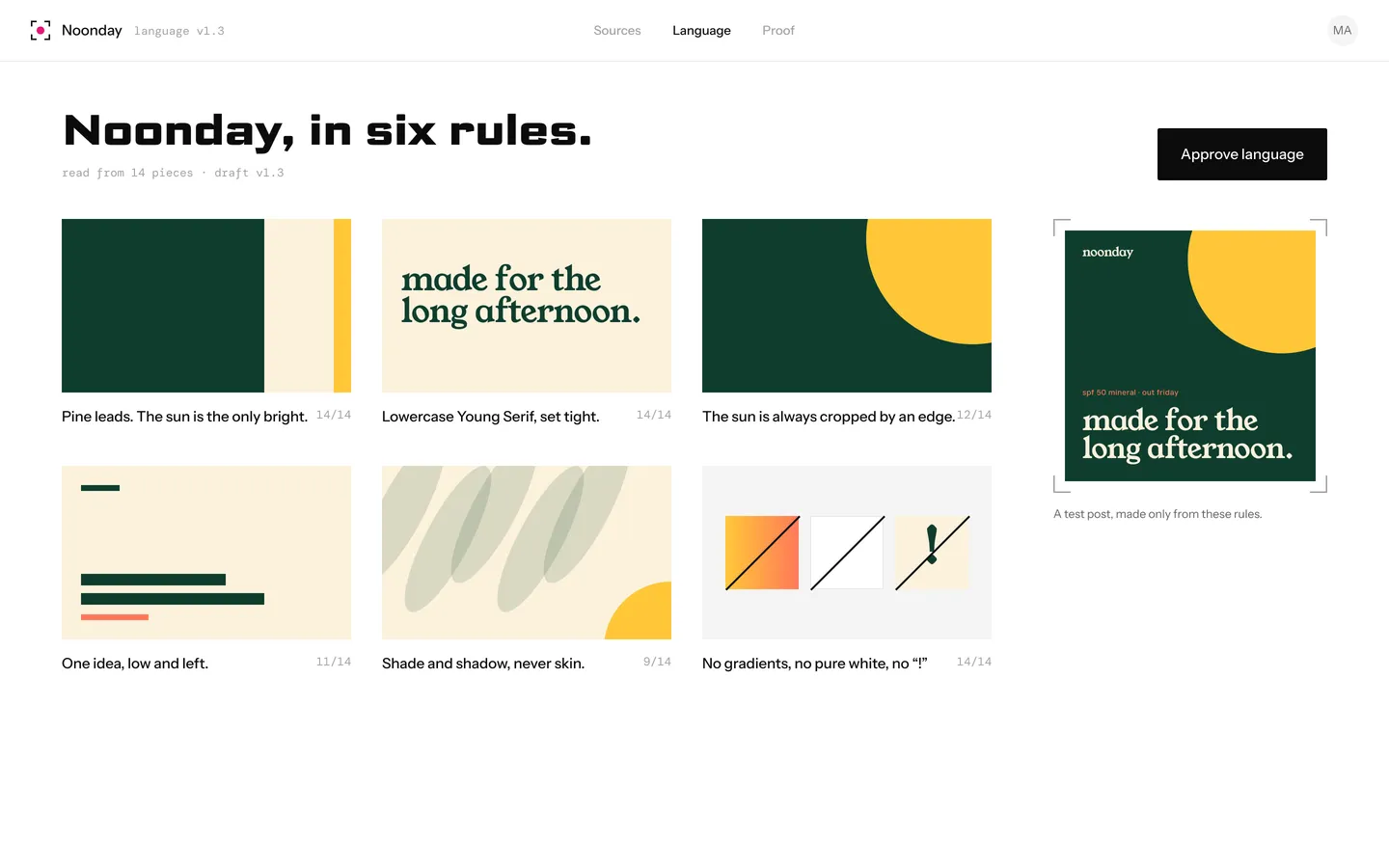
02 / 06
Language
Six rules, each a small picture and one line, with the evidence count. A test post made only from those rules sits beside them. One action: approve.
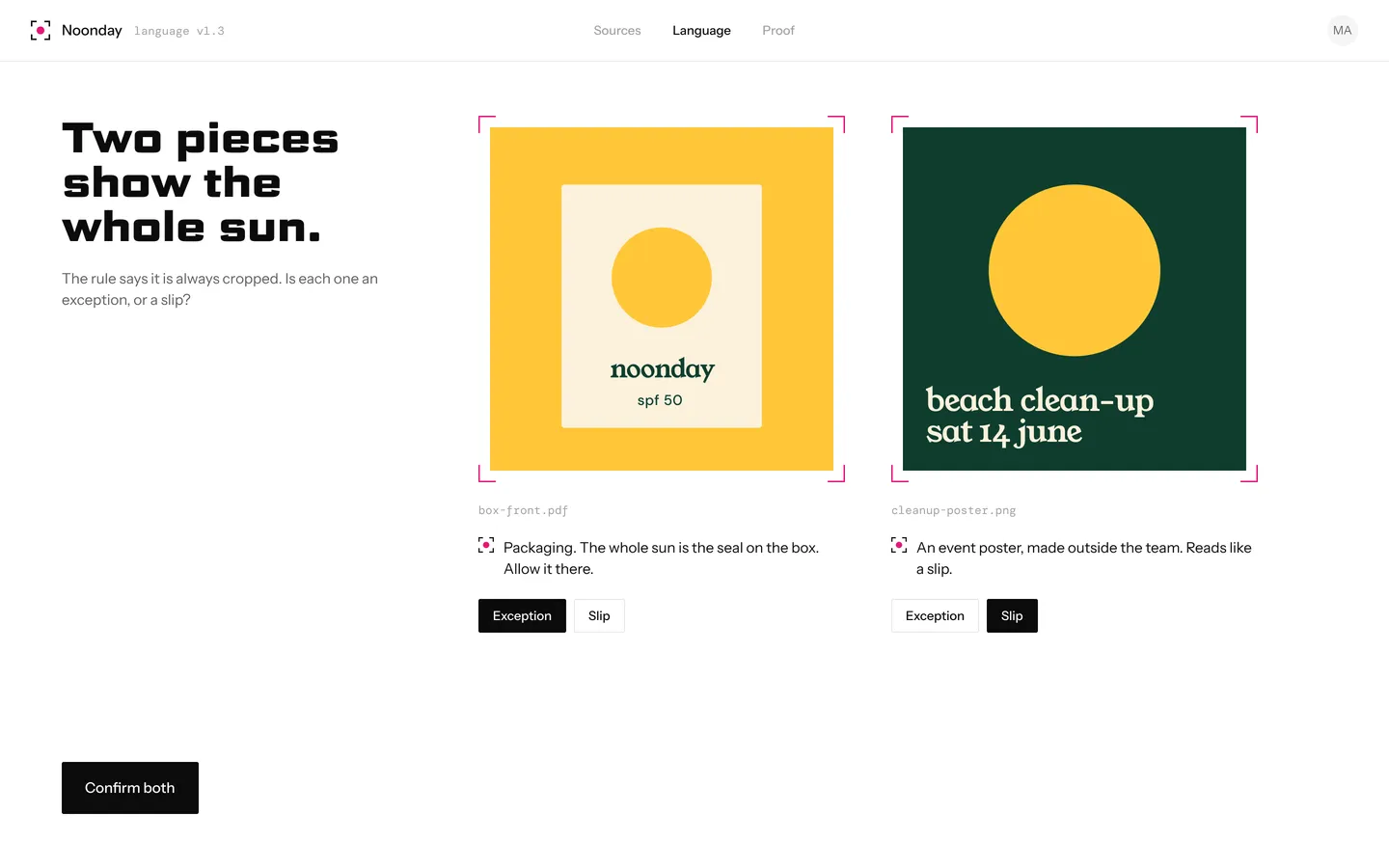
03 / 06
Exception or slip
Two old pieces break “the sun is always cropped”. The agent suggests packaging is an exception and the event poster was a slip. The owner confirms.
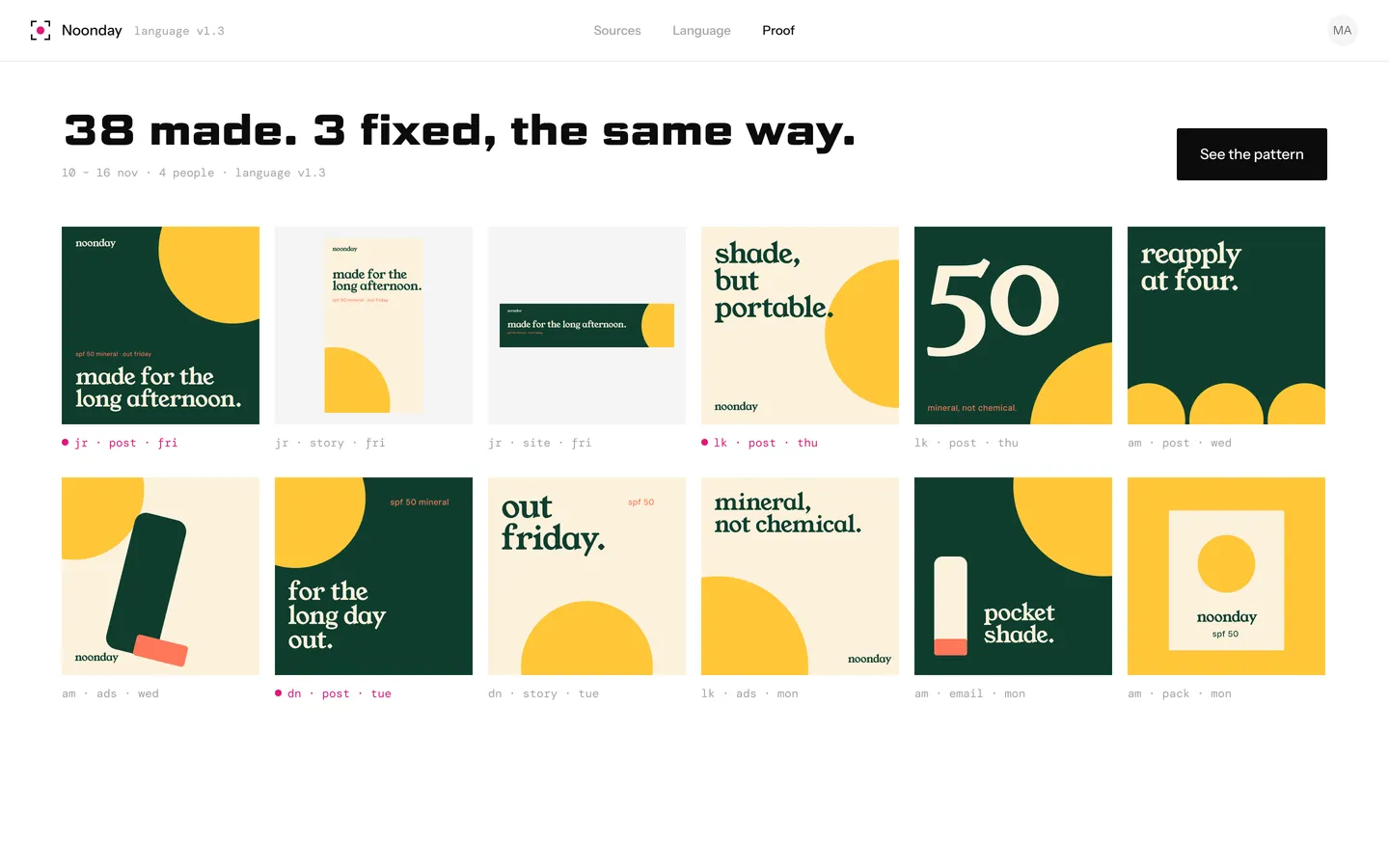
04 / 06
Proof
This week’s artifacts as a contact sheet. 38 made, three fixed, and the three are marked.
05 / 06
Learning
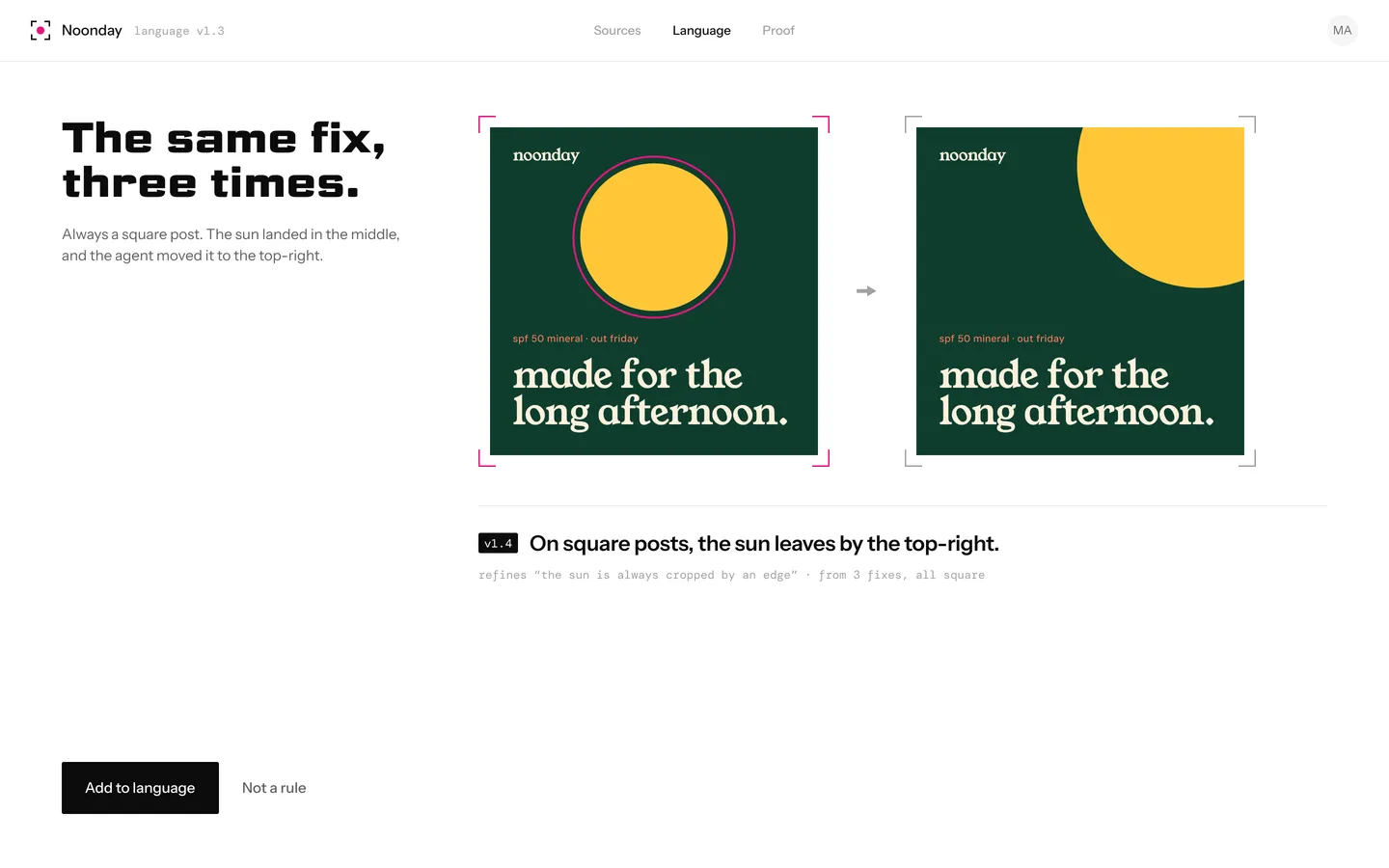
The same fix happened three times, always on square posts. The agent proposes a refinement, shown as before and after.
06 / 06
v1.4
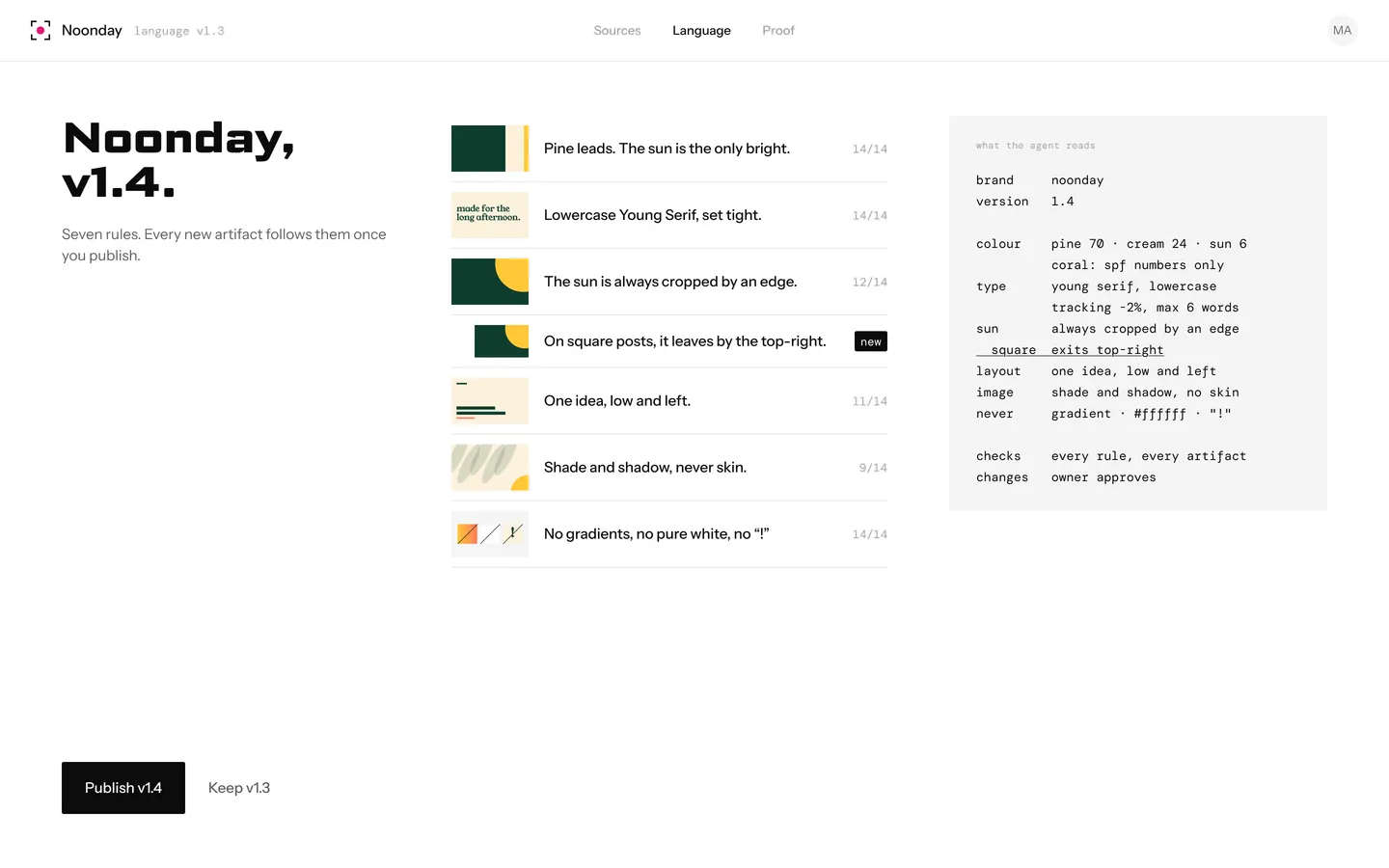
The rules as pictures next to exactly what the agent reads. Publish, or keep v1.3.


Mobile, where a marketer asks and approves in a minute / 5 screens
01 / 05
Ask
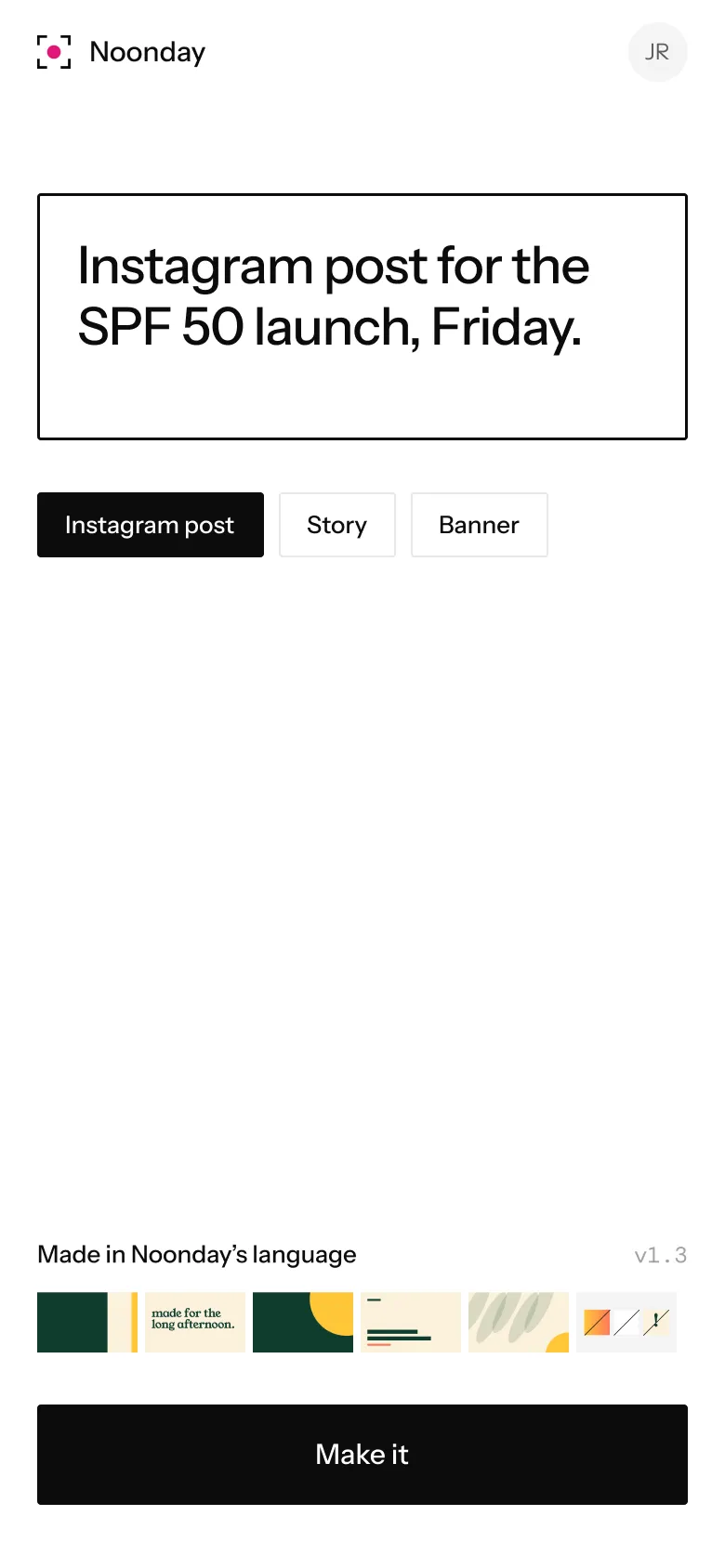
“Instagram post for the SPF 50 launch, Friday.”
02 / 05
One thing off
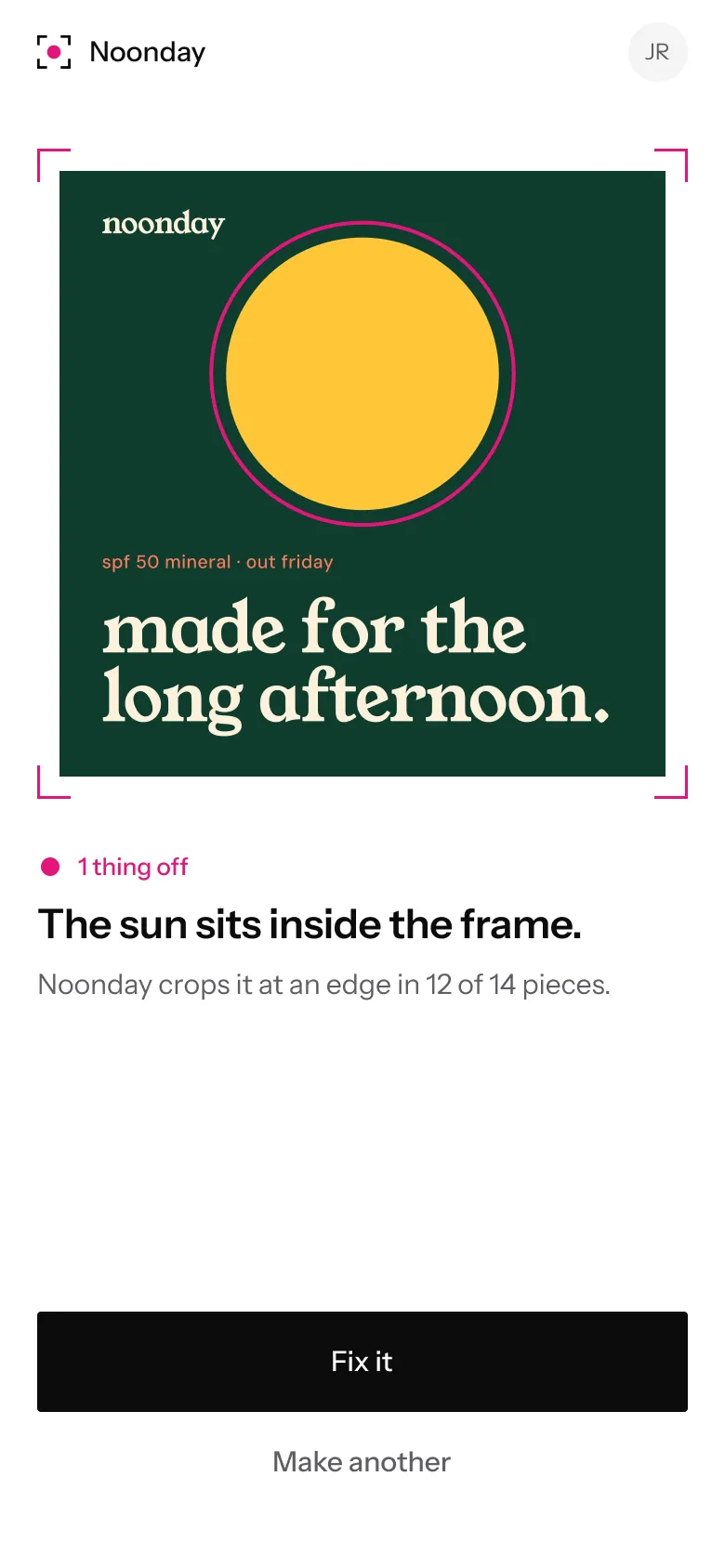
The draft, with the sun ringed. “The sun sits inside the frame.” One action: fix it.
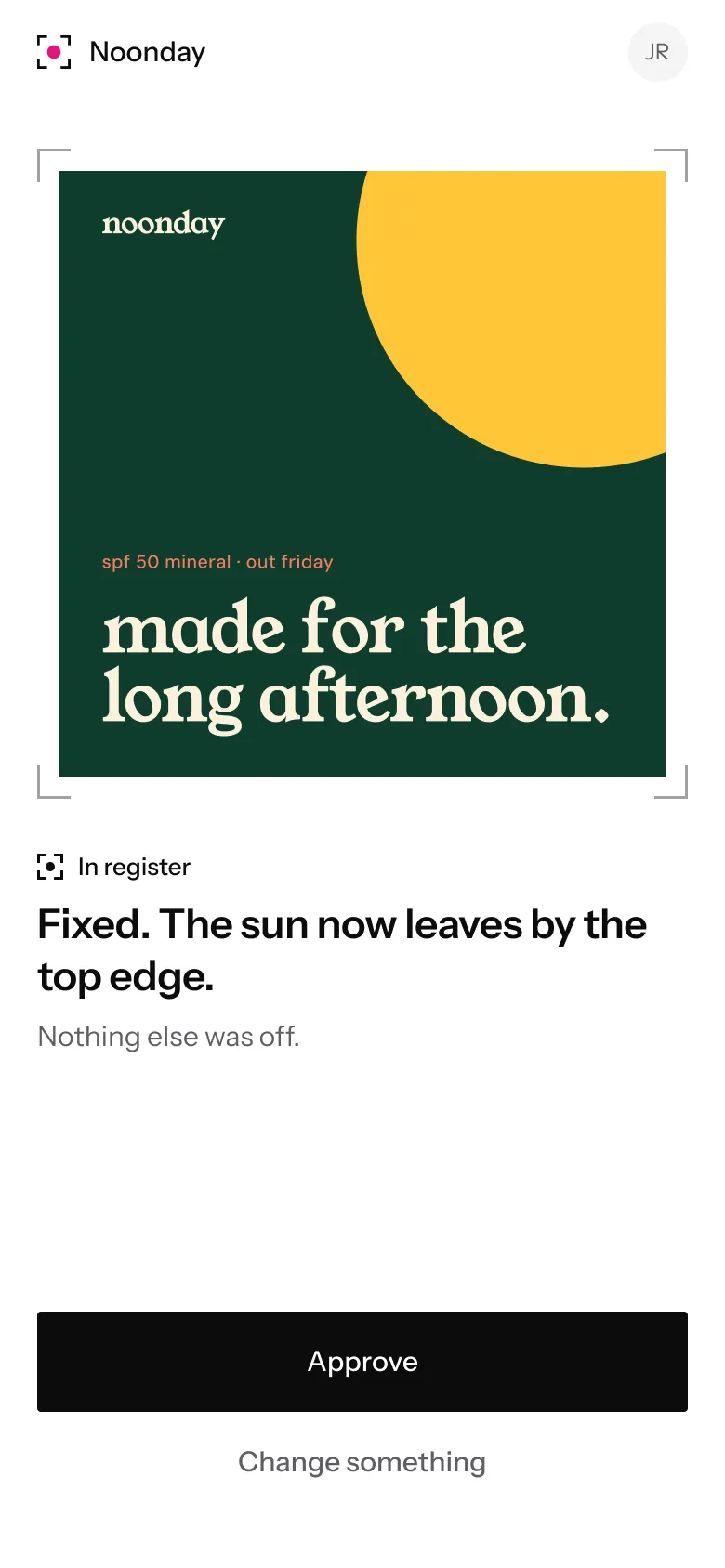
03 / 05
In register
Fixed. Nothing else was off. Approve.
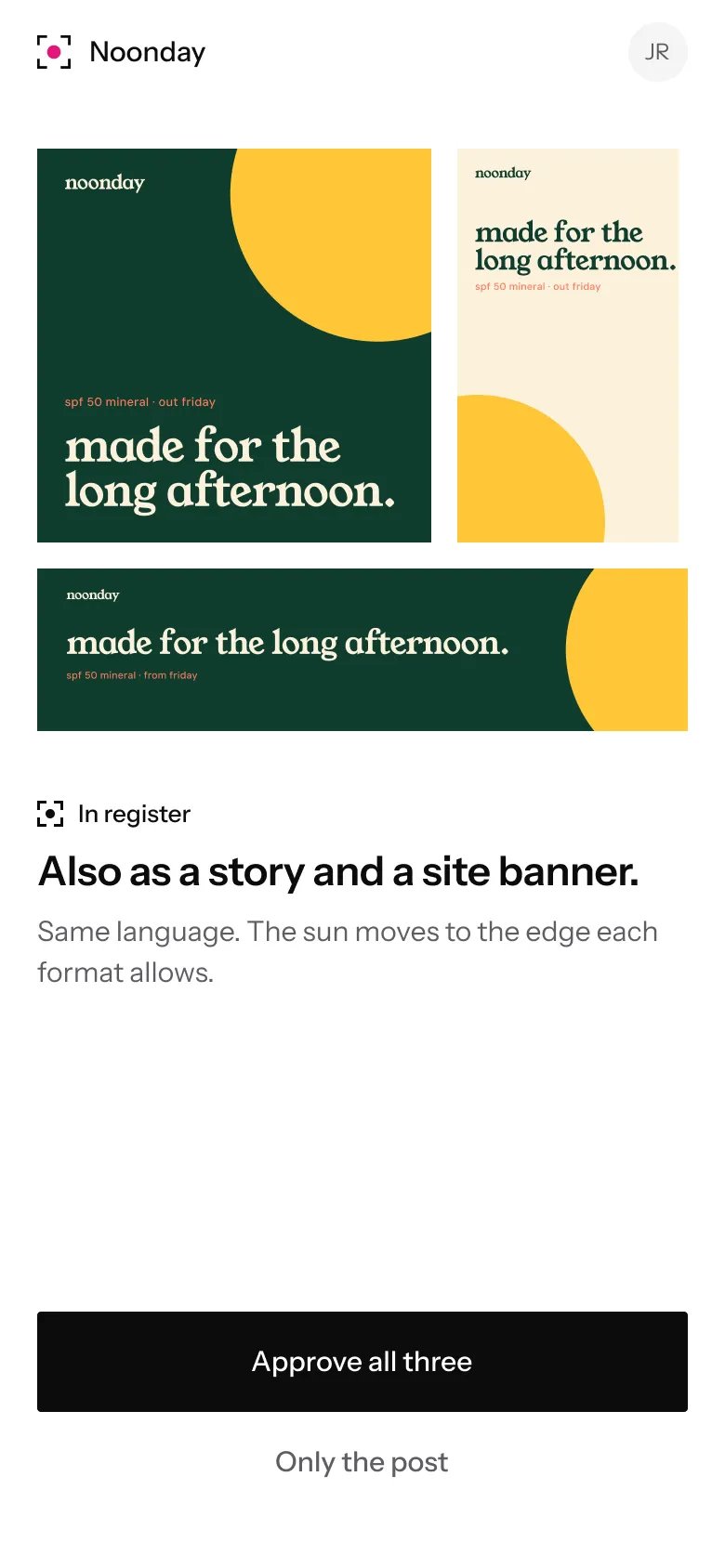
04 / 05
Formats
The same post as a story and a site banner. Approve all three.
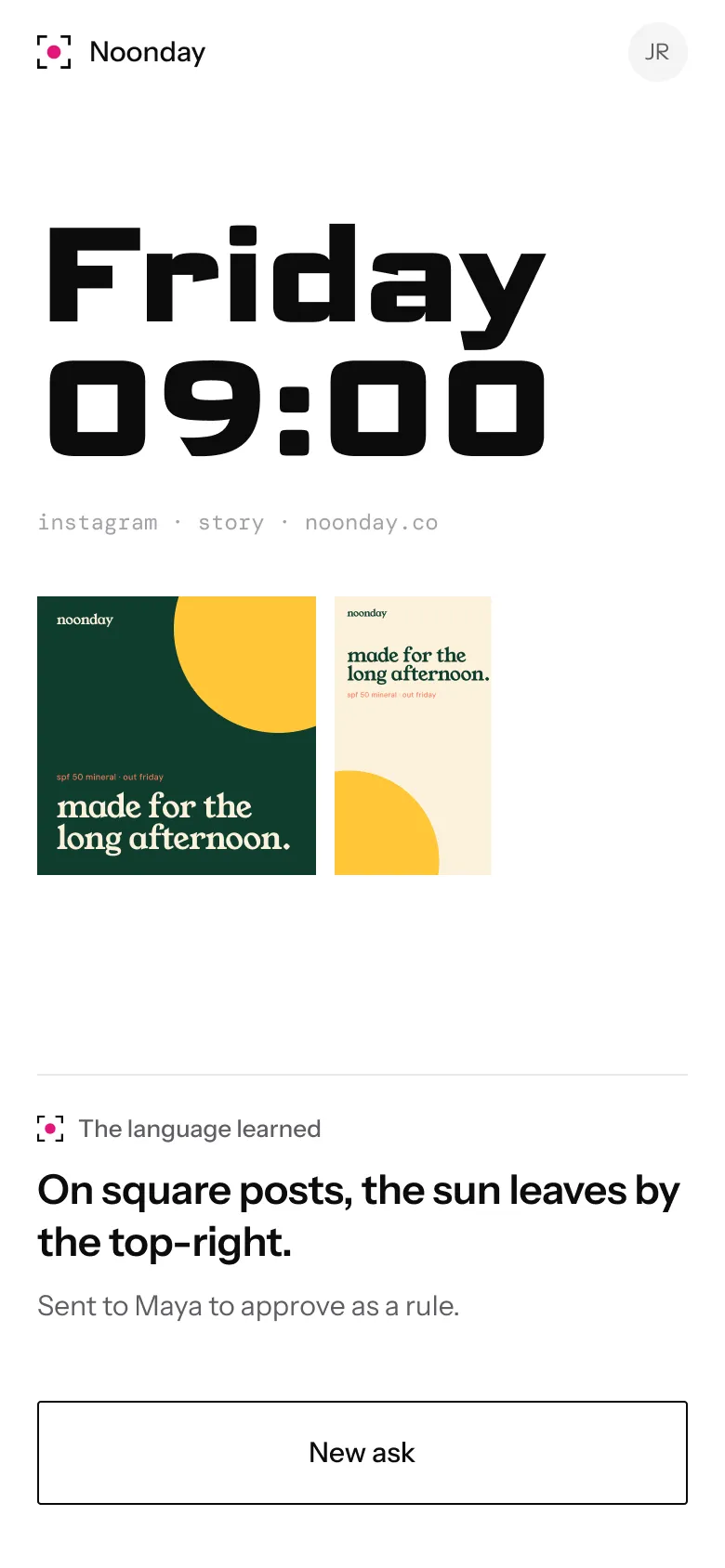
05 / 05
Scheduled
Friday 09:00, and what the language learned from the fix.


No dashboards, no score rings, no empty or error states. Every screen shows the one thing to know, the one thing to do, and the one thing that helps.
03 / Brand identity
A creative tool, not an AI startup.
The product chrome is ink on white and steps back, so the customer’s brand is the only colour on screen. BRANDVERSE’s own identity lives in a few places.
The wordmark is BRANDVERSE in Science Gothic Black capitals: an extended, technical grotesque that reads like the labels on a printing plate. The S’s spine sits slightly off-axis, like a plate a little out of register, and that is the one imperfection kept on purpose. The symbol is four crop corners and a magenta point: the frame is the language; the point is the one thing to look at.
Proof magenta is borrowed from the proofreader’s pen. It appears only where something is off, so it keeps its meaning. One motion, “snap to register”, carries the product: ring, close to a point, move, go quiet, in 400ms with no bounce. The voice says the one thing: “The sun sits inside the frame,” never “Brand compliance score: 82%.”
- Proof magenta
- #E5157A, only what is off
- Ink
- #0B0B0C on white
- Display
- Science Gothic
- Interface
- Instrument Sans
- Values and spec
- DM Mono


04 / Design systems
A small, quiet system, so the customer’s brand can be loud.
Colour and type are Figma variables and text styles. Spacing runs 4 to 96, radius is 2 on chrome (avatars are the only round thing), hairlines are 1px, and there are no shadows.
Components with variants are used as instances in every screen, including the Noonday sample artifacts: the post off and in register, the story, the banner and ten pieces of past and generated work.
Components
Rules
- Magenta only for the one thing that is off.
- One named deviation, never a score.
- The agent proposes; a person changes the language.
- Chrome steps back: ink on white, radius 2, no shadows.
From BRANDVERSE’s tokens.json, rendered live in its own type
Colour
- paper#FFFFFF
- well#F5F5F4
- line#E7E7E9
- ink#0B0B0C
- ink-2#5E5E63
- ink-3#A1A1A6
- magenta#E5157A
- magenta-tint#FDE7F1
Type
- display-xlScience Gothic 900 / 160px / 0.95 / -1%
The sun sits inside the frame.
- display-lScience Gothic 700 / 72px / 1 / -2%
The sun sits inside the frame.
- display-mScience Gothic 700 / 44px / 1.05 / -2%
The sun sits inside the frame.
- display-sScience Gothic 600 / 28px / 1.15 / -1%
The sun sits inside the frame.
- ui-askInstrument Sans 500 / 28px / 1.18 / -2%
The sun sits inside the frame.
- ui-titleInstrument Sans 600 / 22px / 1.25 / -1%
The sun sits inside the frame.
- ui-bodyInstrument Sans 400 / 15px / 1.45
The sun sits inside the frame.
- ui-body-strongInstrument Sans 500 / 15px / 1.45
The sun sits inside the frame.
- ui-labelInstrument Sans 500 / 13px / 1.3
The sun sits inside the frame.
- ui-captionInstrument Sans 400 / 12px / 1.35
The sun sits inside the frame.
- mono-valueDM Mono 400 / 12px / 1.4
IN REGISTER · 12 OF 14
- mono-smallDM Mono 400 / 10px / 1.4 / 2%
IN REGISTER · 12 OF 14
Spacing
- 4
- 8
- 12
- 16
- 24
- 32
- 48
- 64
- 96
Radius
- none / 0px
- chrome / 2px
- full / full

05 / Development
Snap to register, built live.
The whole idea in one gesture: the agent names one thing, a person says fix it, it snaps into the language, and the marks go quiet. The post is drawn in HTML, not an image, so its parts can move.
1 thing off
The sun sits inside the frame.
How it is built
- Stack
- One React component and CSS transitions; transforms only for the move, so it stays on the compositor
- Tokens
- Proof magenta, ink, crop-mark and motion values from BRANDVERSE’s tokens.json; Noonday’s sample colours from the same file
- Type
- Instrument Sans and DM Mono for the product, Young Serif and DM Sans for Noonday, served from this site
- Access
- Real buttons; the post has an accessible name; the status is announced politely; ring and marks are hidden from screen readers
- Motion
- 400ms with no bounce; reduced motion goes straight to the final state with a 120ms cross-fade

Talk to us
We love to talk design.
Tell us about your product, the people who use it and where it hurts. We are happy to talk design, user experience and how design can set you up for success.