Self-initiated / Mobile and desktop / 2026

An onboarding agent that banks put inside their own apps. Their clients just talk to it.

- Type
- Self-initiated project
- Sector
- Banking and wealth platforms, onboarding
- Platforms
- Mobile and desktop
- Services
- Strategy and research
- Product design
- Brand identity
- Design systems
- Development
The person and the agent
The person is a busy principal: the least informed about most of her own file, and the only one who can answer a few parts of it. The agent reads, drafts, splits the questions by who knows what, contacts her people and assembles the file. She does three things herself: confirms who she is, answers the one declaration no one else may make, and holds the seal. Behind both is a third party, the institution, which dressed Kith in its own colours and receives the result.
A self-initiated project: no client, not launched, no users or results. Every person, company and figure in the screens is invented.
01 / Strategy and research
Ask the person who knows. Let the bank keep its own face.
The problem
Institutions must understand who a client is and who owns and controls the structures behind them. For a wealthy client that turns into a long questionnaire addressed to one person and forwarded by email to the people who actually know. Neobanks and investment platforms moving up-market have it worse: their onboarding was built for a mass-market sign-up form.
Two observations
The principal is rarely the person who holds the answers, and she already trusts her bank, not her bank’s vendors. So Kith is white label: the institution buys it and puts it inside its own app; the client meets an agent in a look she already knows.
Two audiences
For the institution: a finished, sourced file, a small console to receive it, and three dials to make Kith look like theirs: colour, type and corners. For the client: a conversation that asks almost nothing, shows what it already found and where from, and makes pointing at a source or a person a single gesture.
What chat costs
A form shows the whole task at once and lets you jump around. We kept that where it matters: a count (“38 of 41”) and the review carry scope; on desktop a side panel shows the whole file; every fact is a structured object with its source. And no chatbot habits: no greetings, no cheering, never two questions in a row.
Trade-offs
One institution per file, not a reusable identity passport. Drafts that people confirm, not answers the agent asserts. Provenance, not confidence scores. The agent called Kith in every host, so its manners stay recognisable. No compliance claims and no risk scoring in front of the client.

Sources
02 / Product design
One conversation, two devices, three people, one institution.
Inside an invented neobank, Vessa, Elena is asked one thing: who already knows you? Every screen answers what to know, what to do and what makes it easier. The thread is short and bottom-anchored; what matters lives in the objects.
The UI rule, on one screen: what Kith found
Know
That covers 23 of 41, and each fact shows where it came from.
Do
Point Kith at the people who handle the rest.
Eases
A square for every source, a circle for every person, and one tap to point.

Mobile / 8 screens
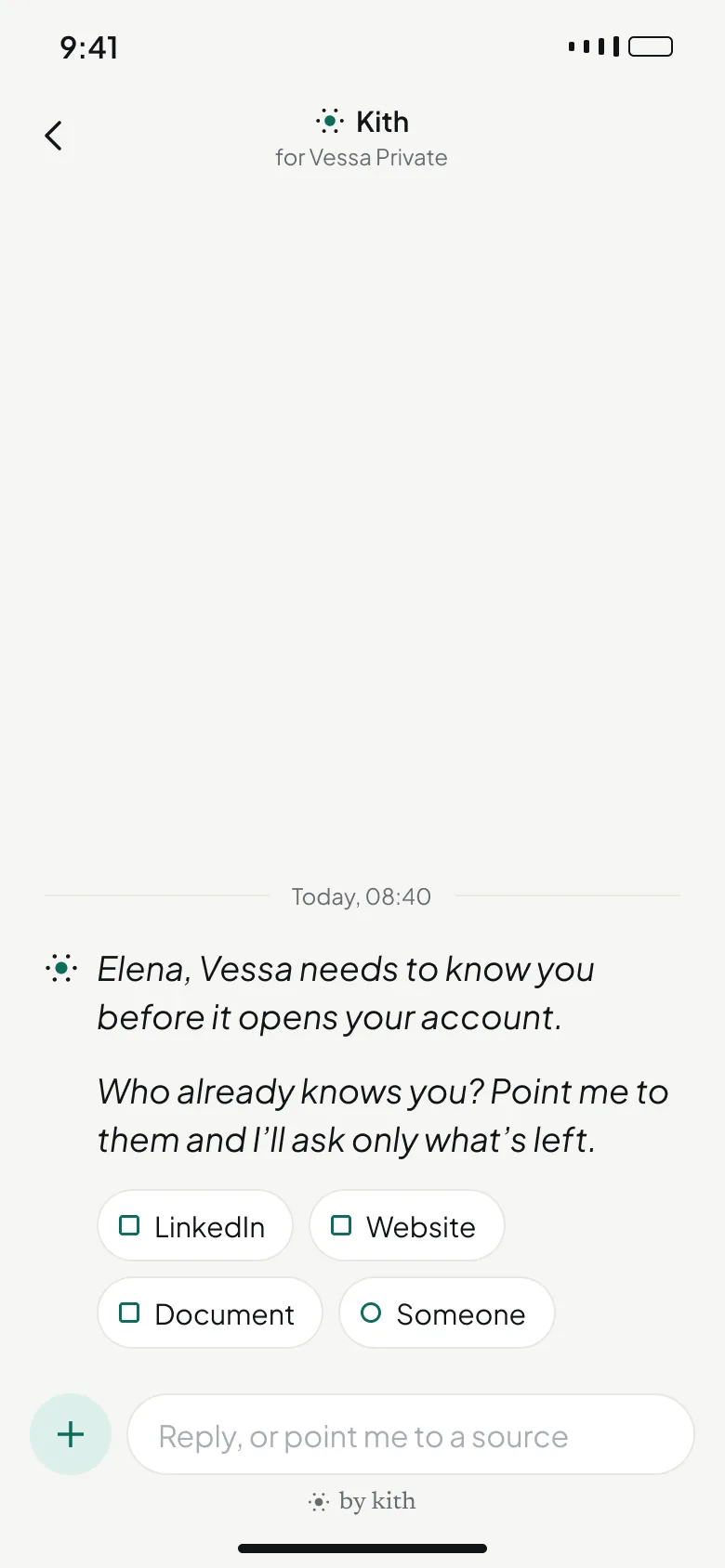
01 / 08
Who already knows you?
One question, inside Vessa’s app, in Vessa’s look.
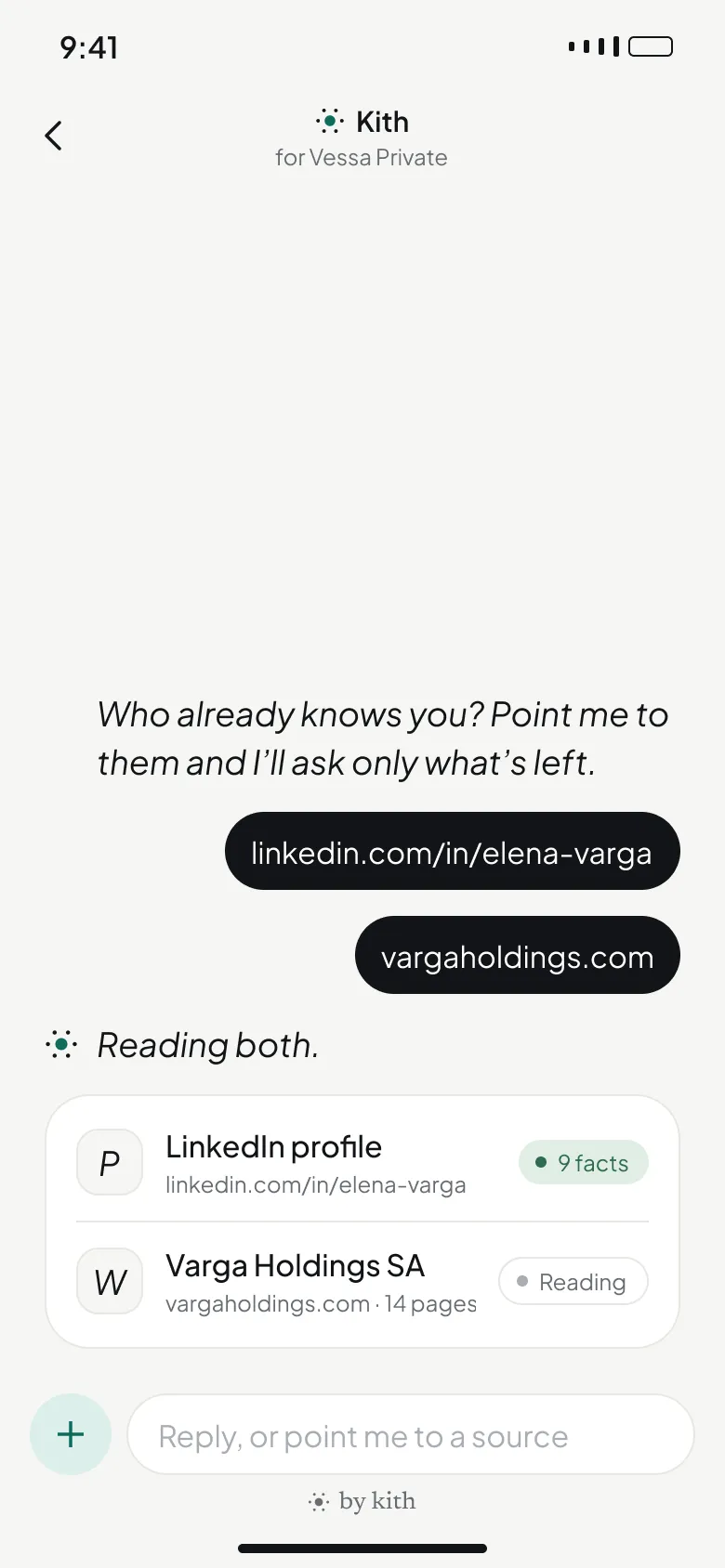
02 / 08
Pointing
She pastes her profile and her company’s website.
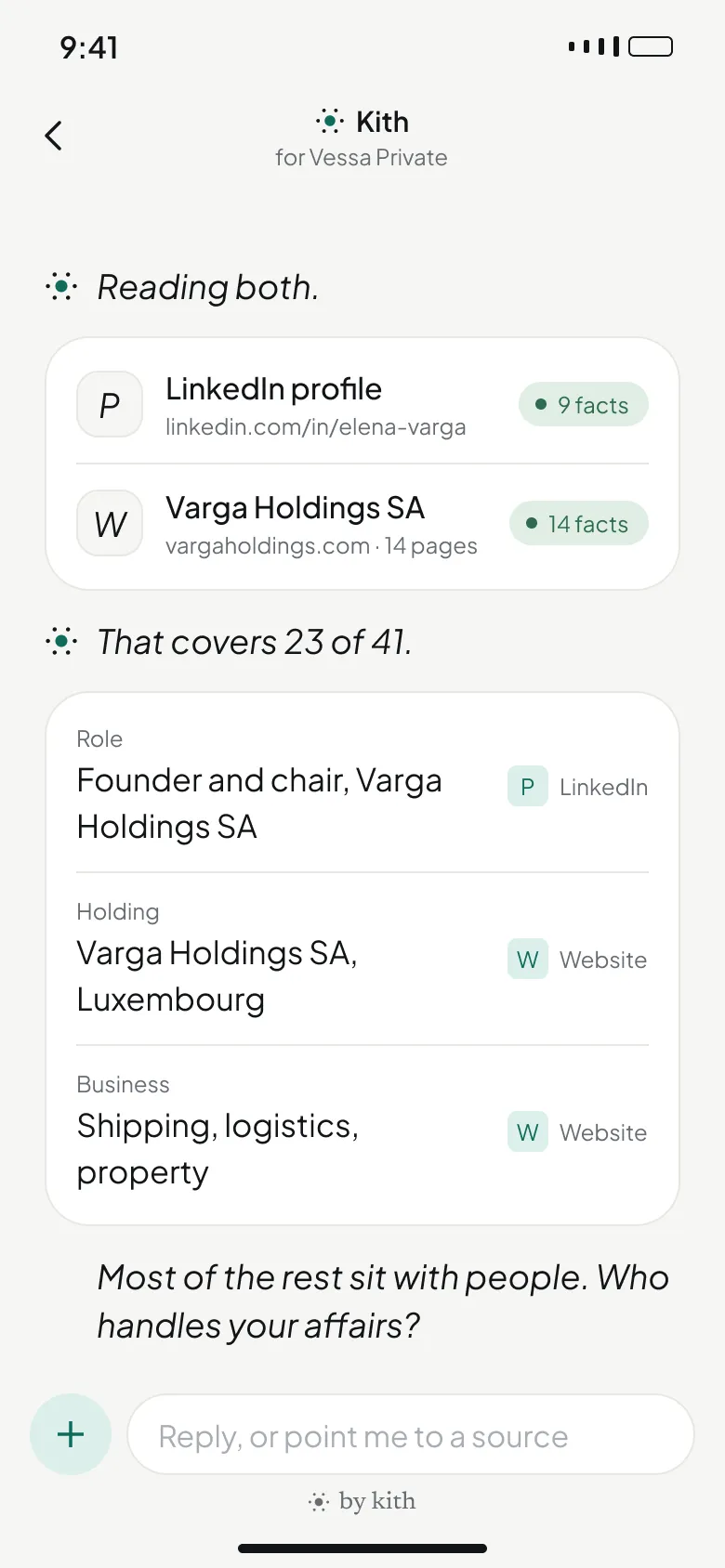
03 / 08
What I found
Kith reads both and shows the facts that matter, each with where it came from.
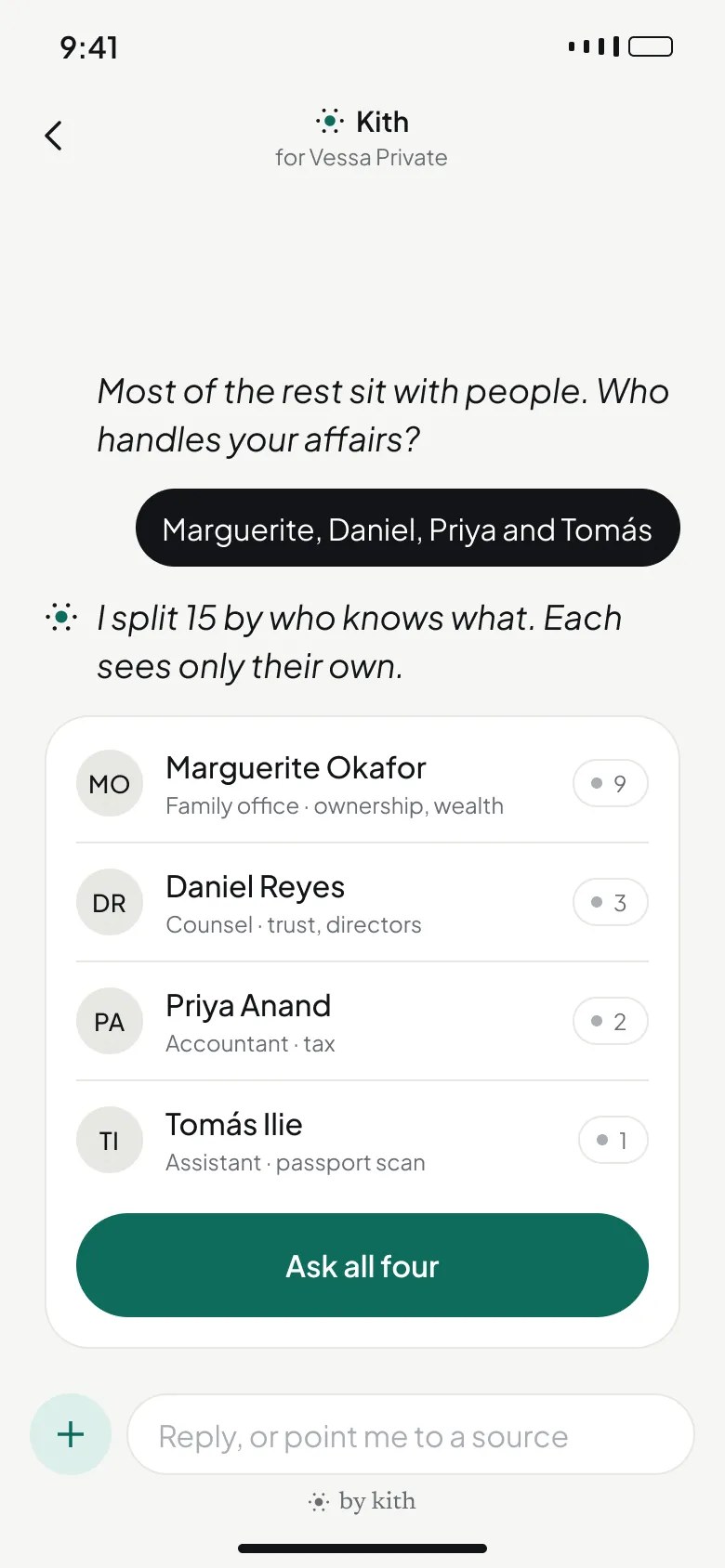
04 / 08
Her people
The rest sit with people. She names four; Kith splits the questions and tells her each sees only their own.
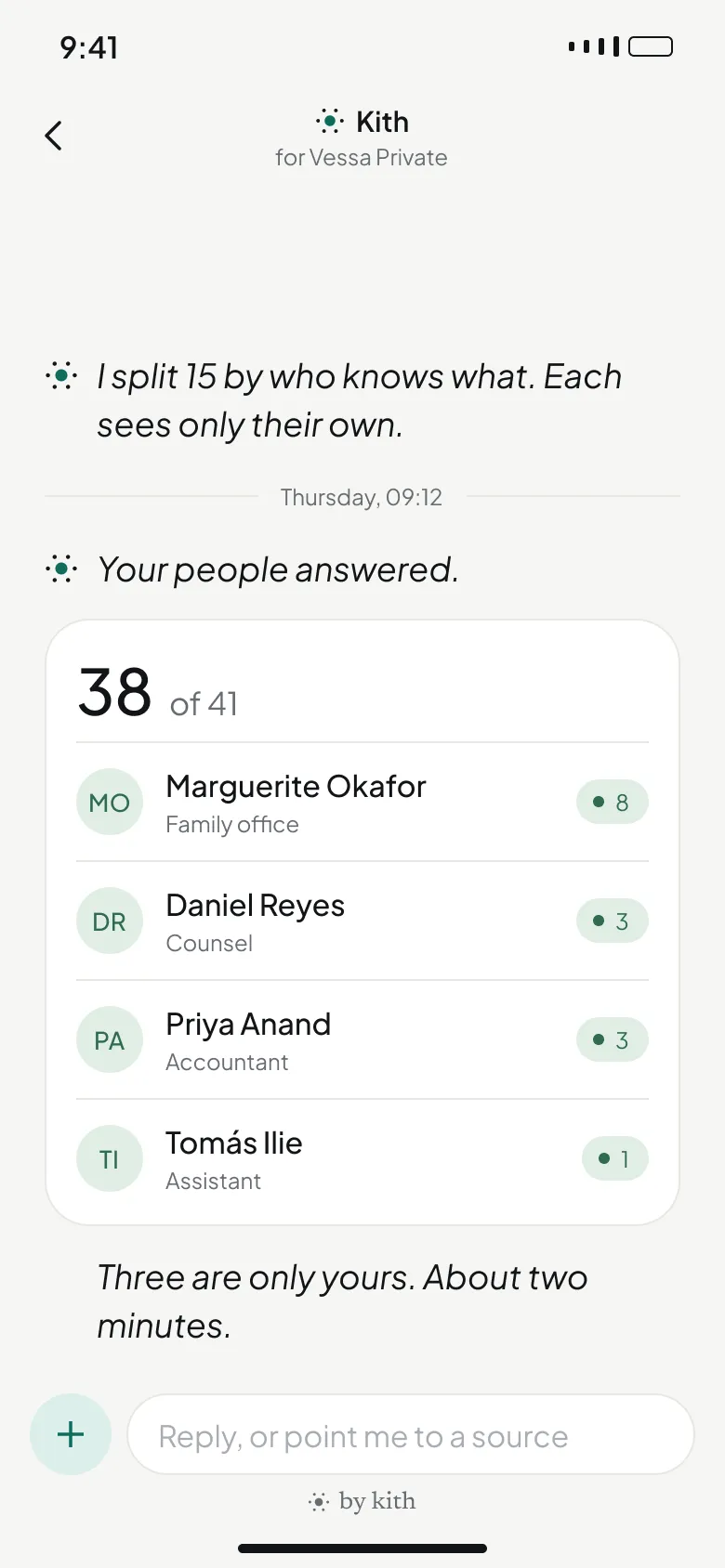
05 / 08
People answered
Two days later: 38 of 41. Three are only hers.
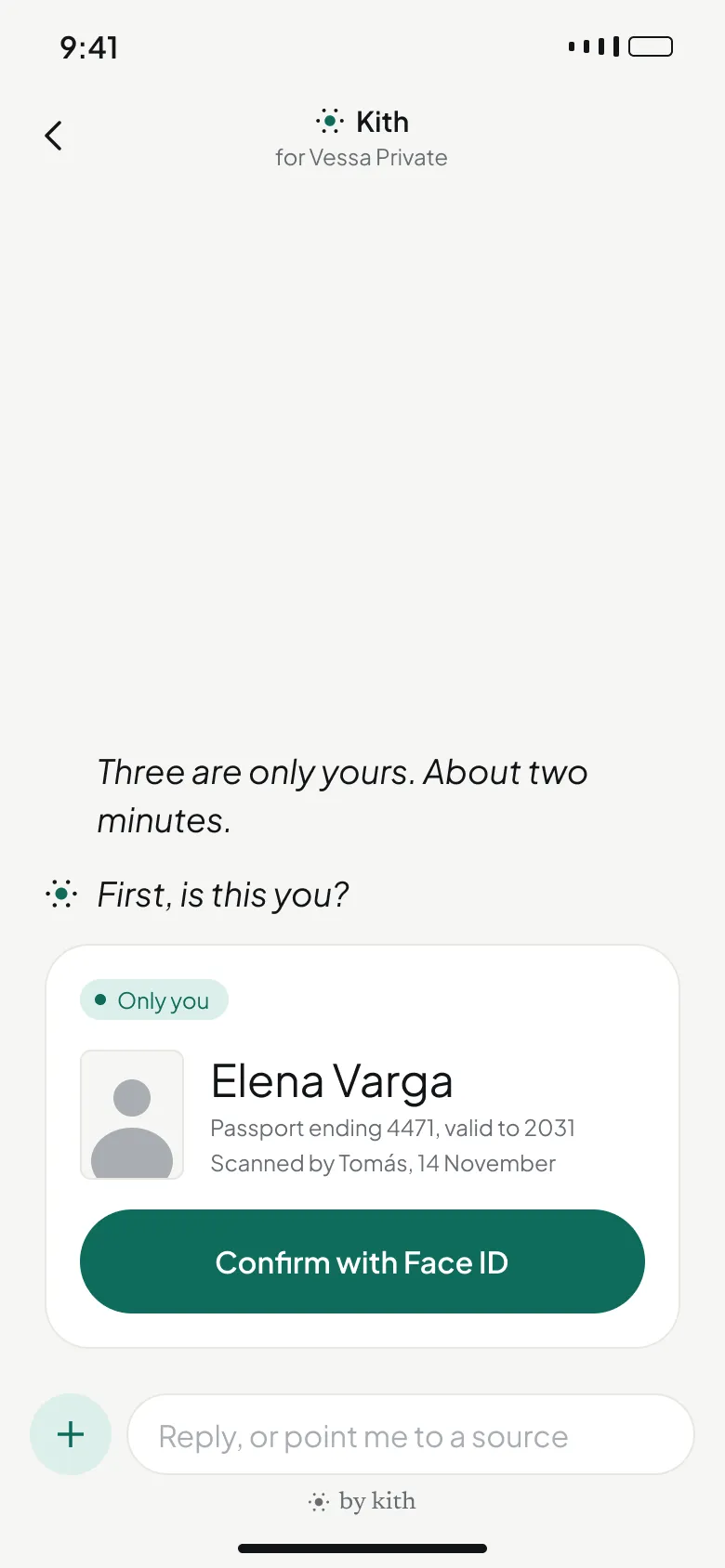
06 / 08
Is this you?
She confirms a passport her assistant scanned, with her face.
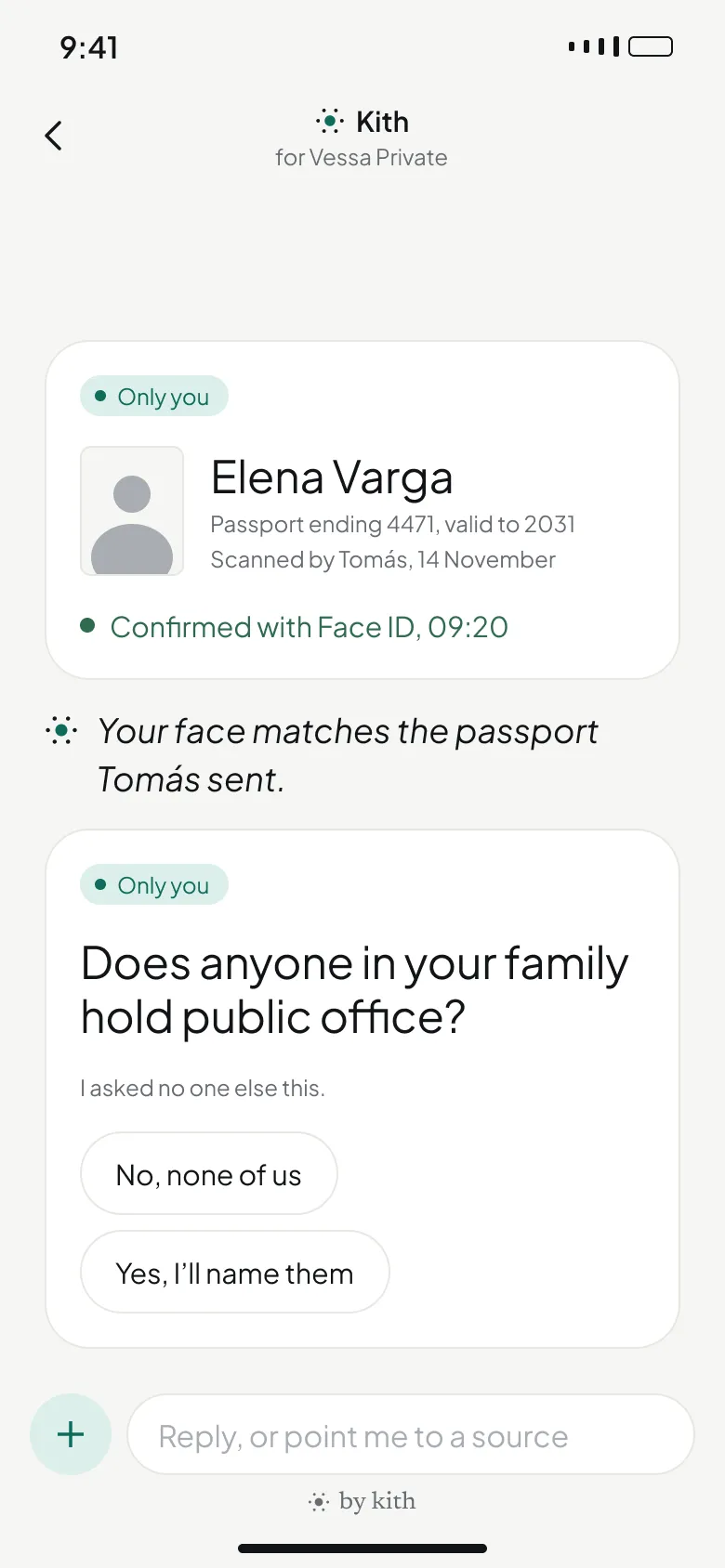
07 / 08
Only you
Does anyone in her family hold public office? Asked of no one else.
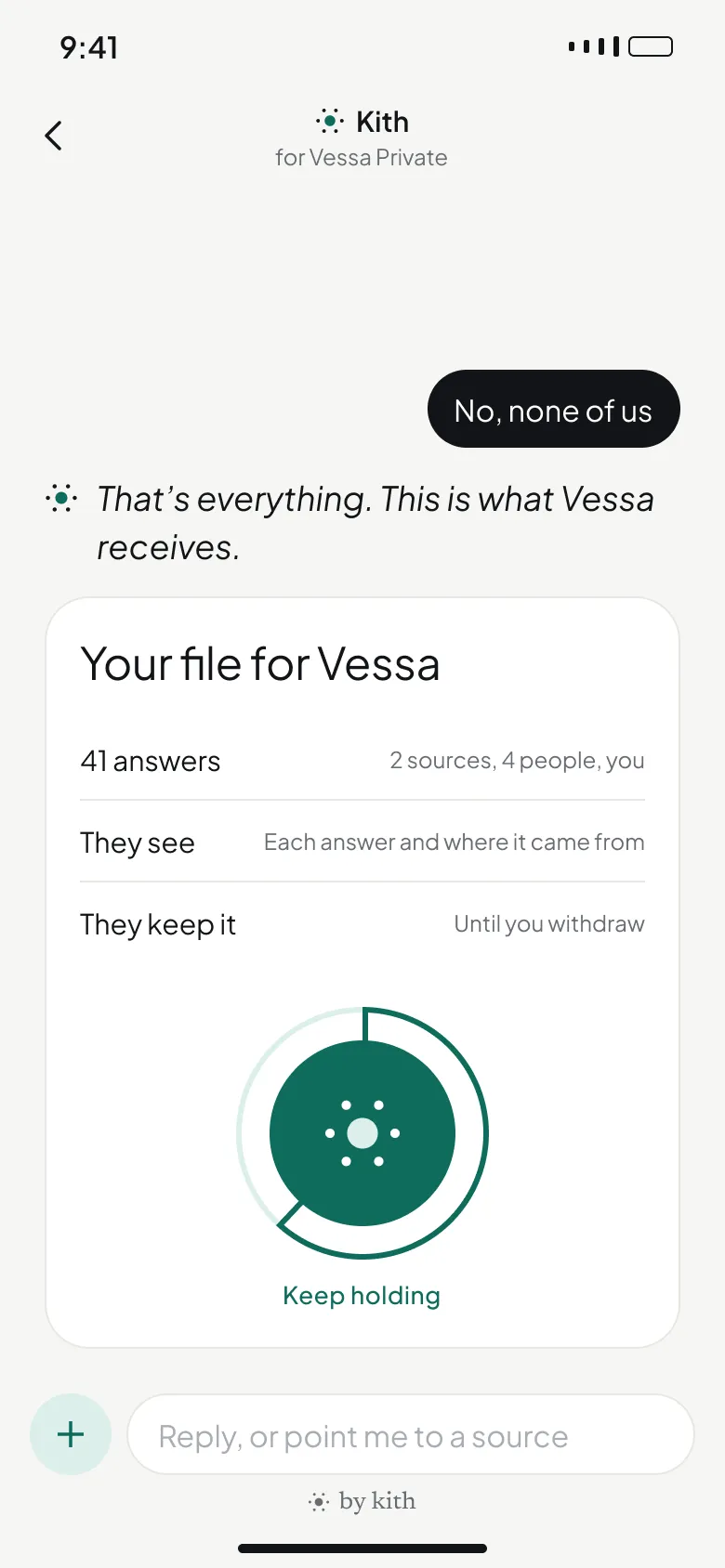
08 / 08
Hold to seal
She reads what Vessa will receive and holds the seal.


Desktop / 6 screens
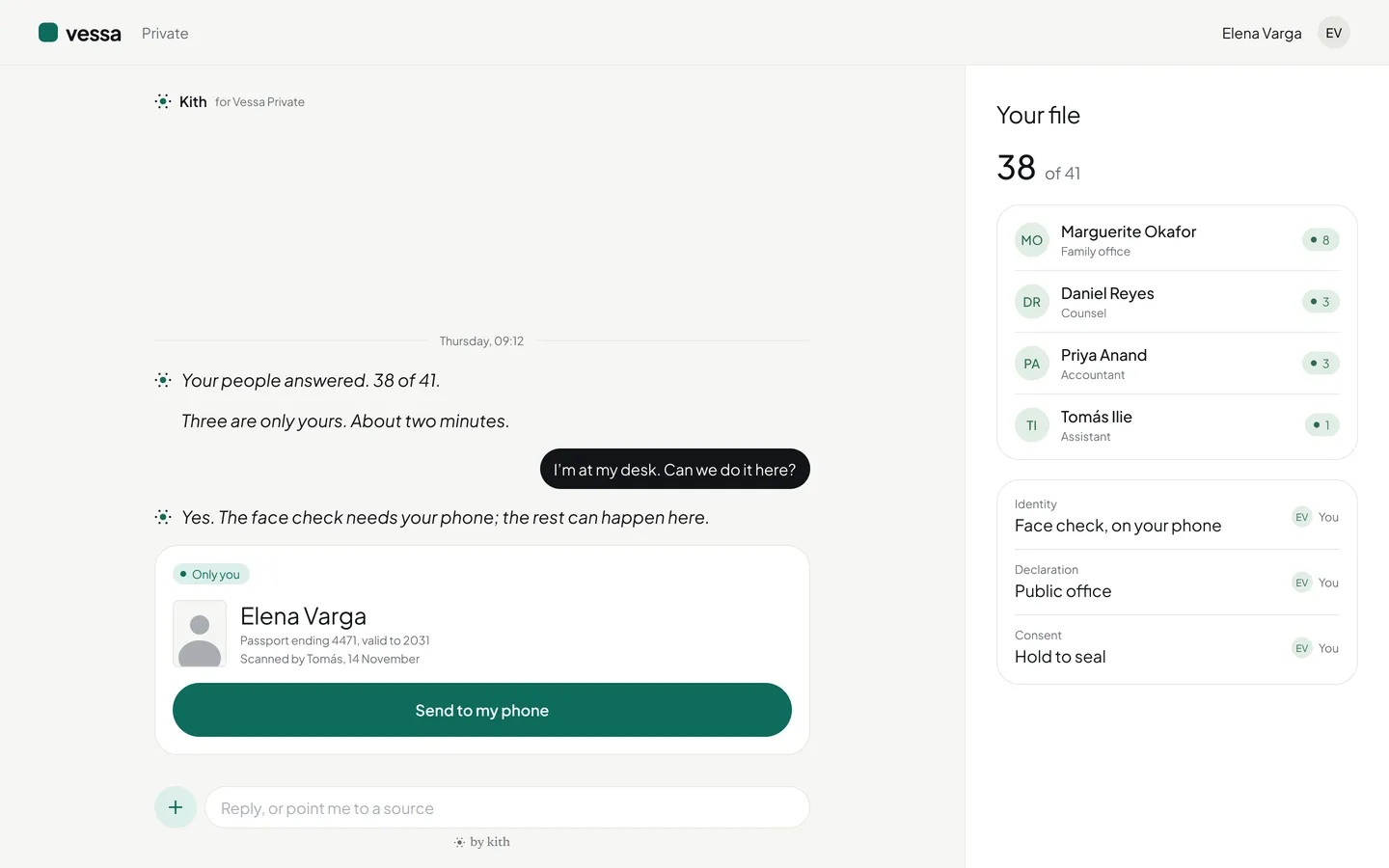
01 / 06
On her laptop
The same conversation continues on her laptop; the face check goes to her phone.
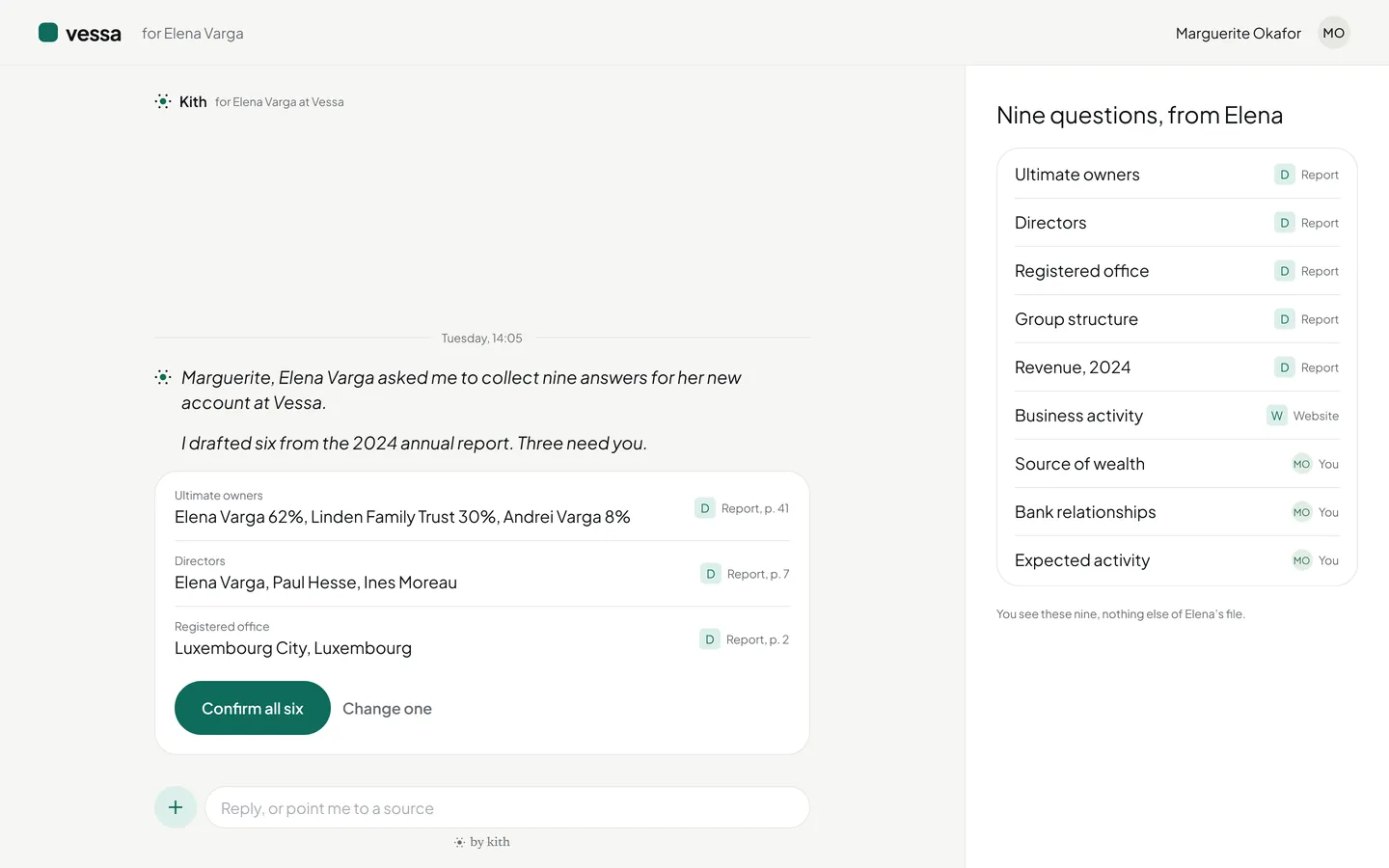
02 / 06
A delegate is asked
Her family-office manager opens a page in Vessa’s look: nine questions, six already drafted from the annual report.
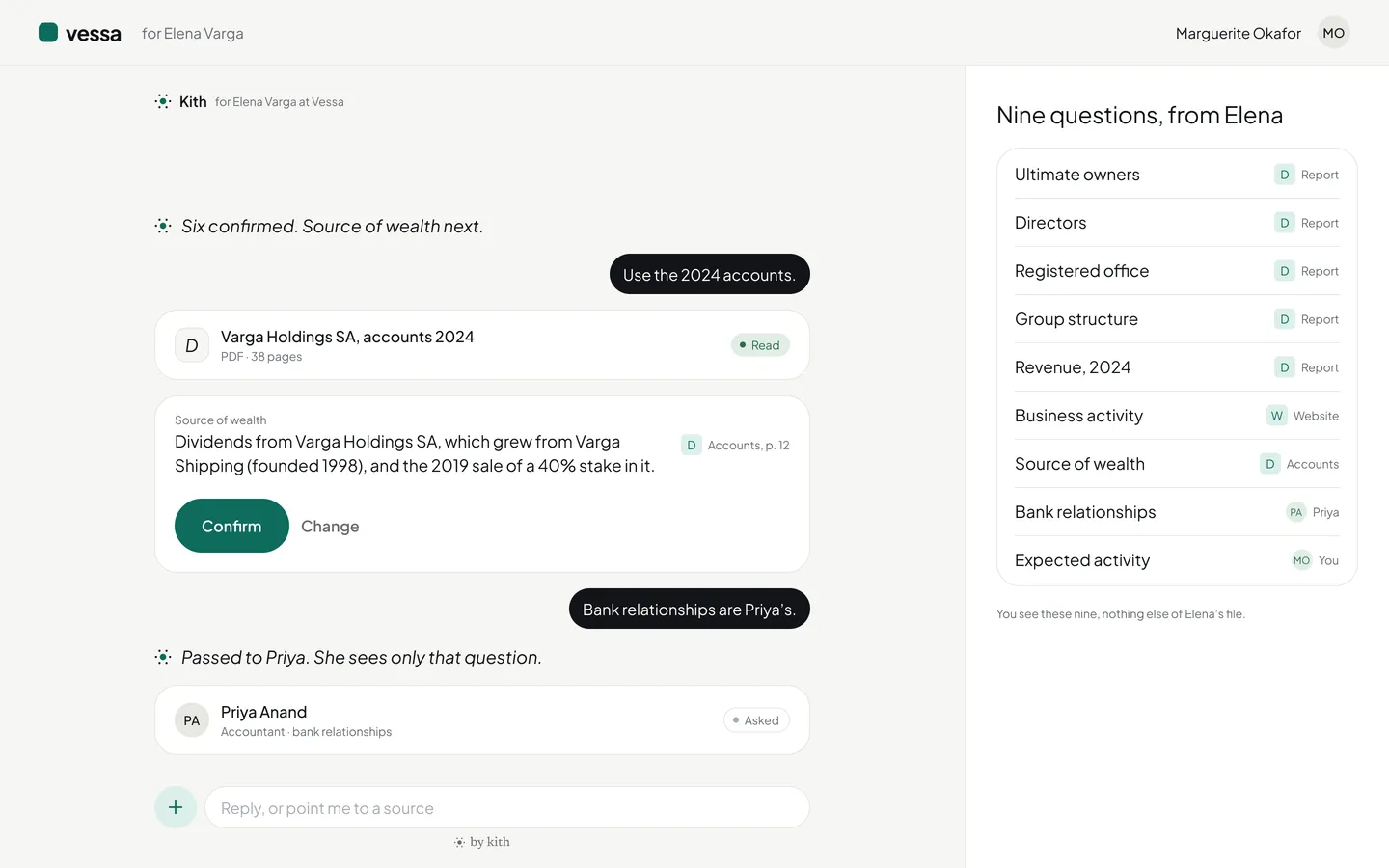
03 / 06
Points and hands on
She drops in the 2024 accounts for the source-of-wealth answer and passes bank relationships to the accountant.
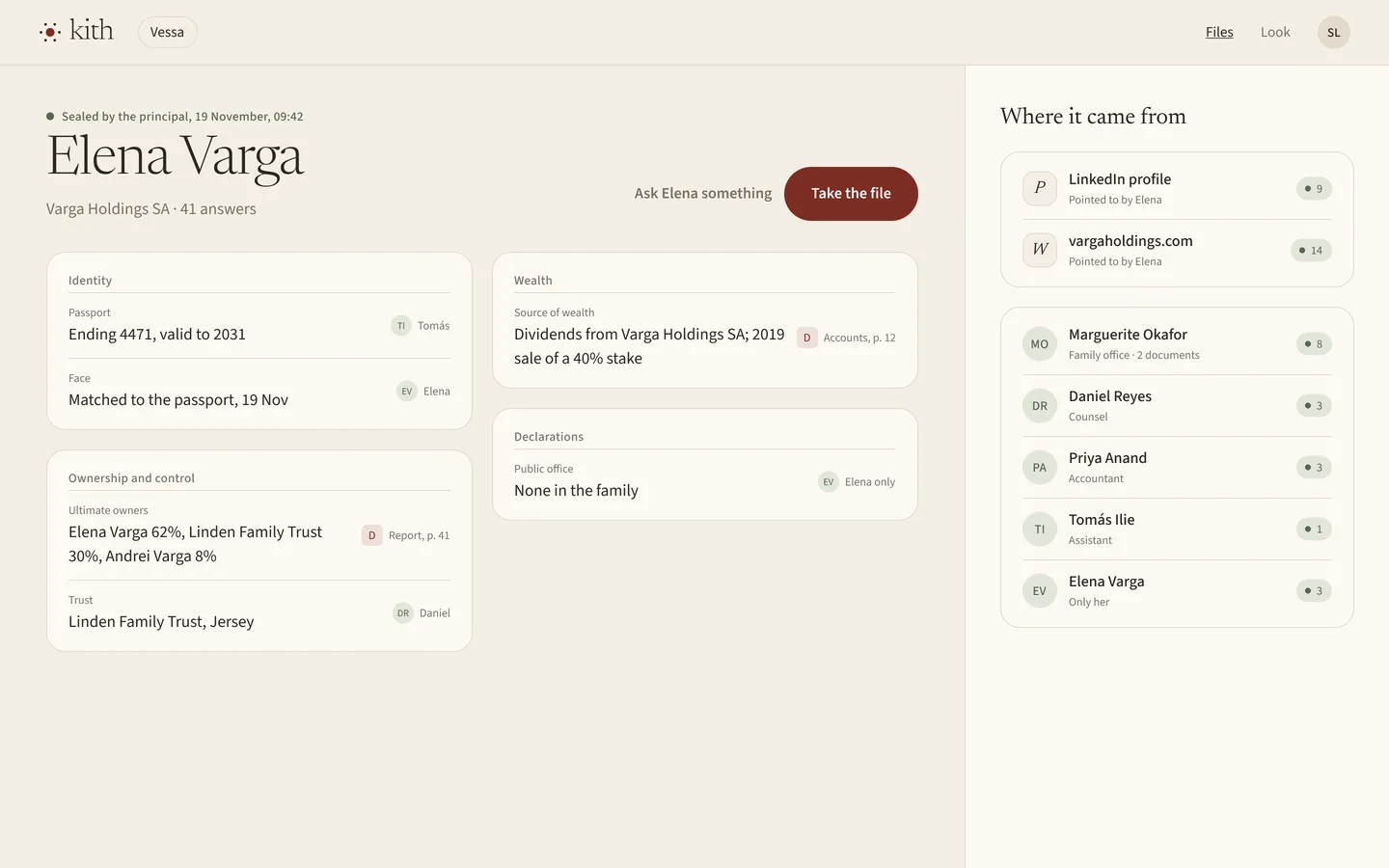
04 / 06
The file arrives
At Vessa, onboarding sees the sealed file arrive in the Kith console.
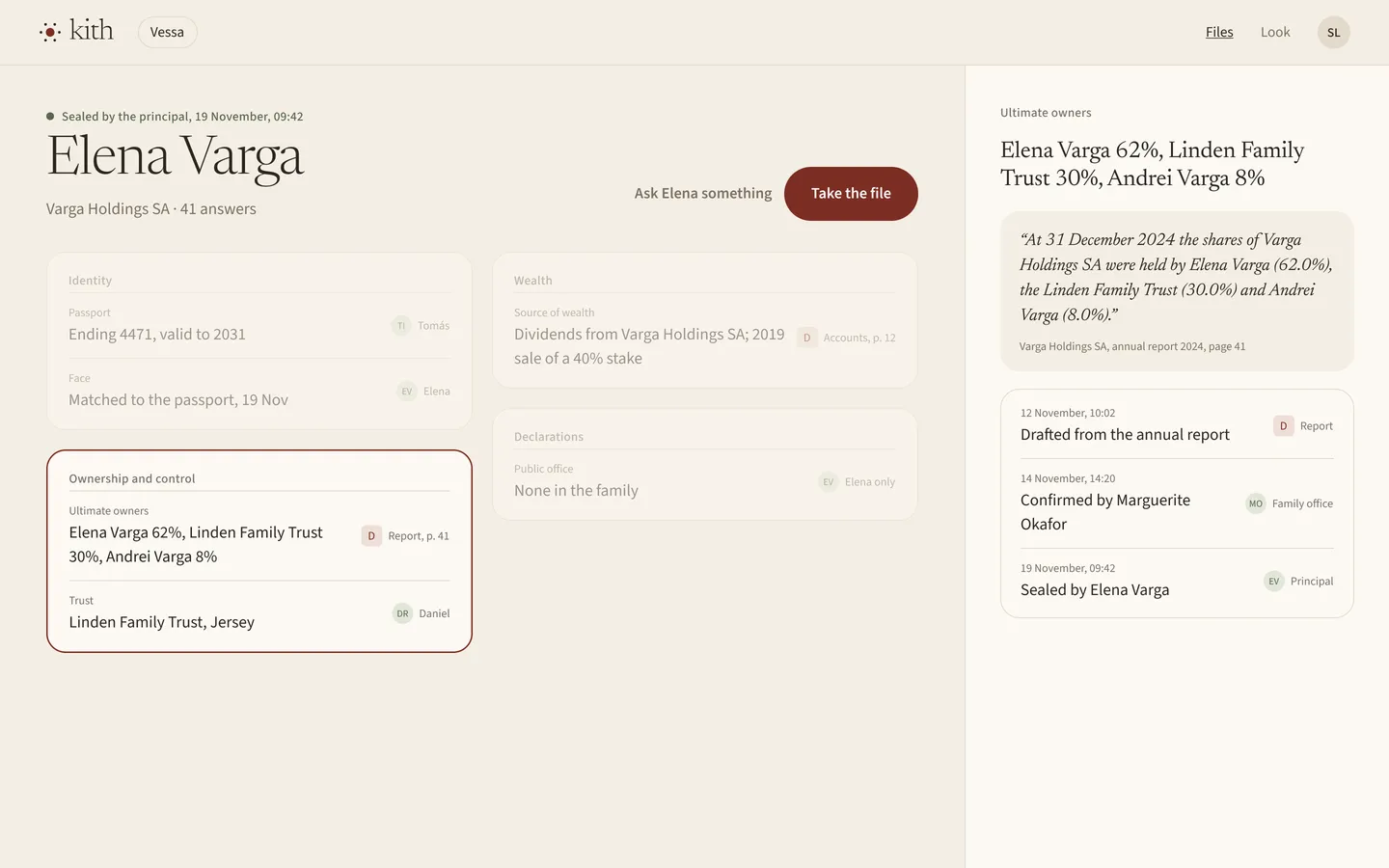
05 / 06
Provenance
The ownership answer opens to the sentence on page 41 it came from, and who confirmed it.
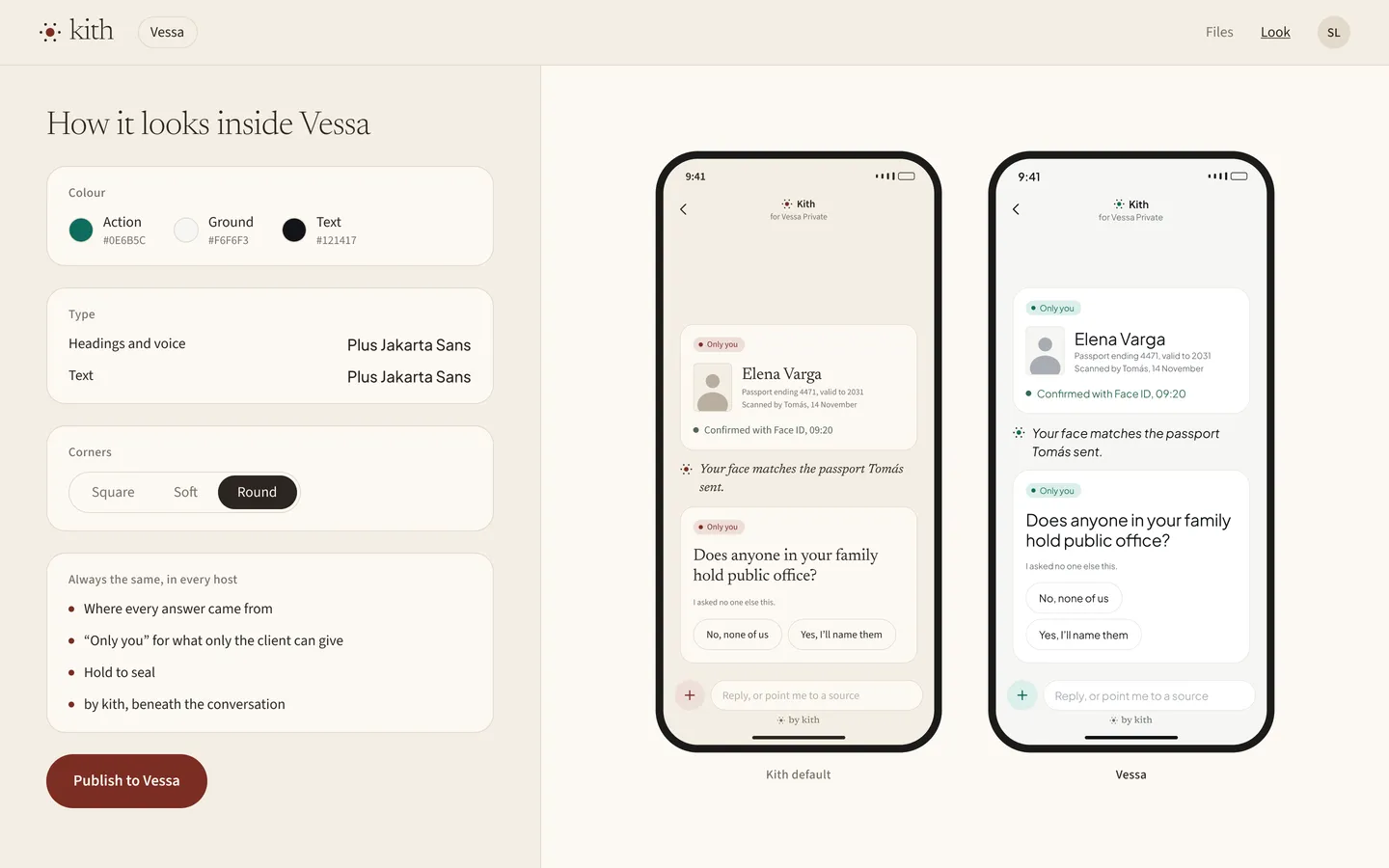
06 / 06
The look
Separately, Vessa sets how Kith looks inside its app: colour, type and corners.


03 / Brand identity
Its own brand, a voice in someone else’s app, and a quiet endorsement.
The name is old English. Kith, from cȳþþ, “knowledge, acquaintance”, means the people who know you. A bank must know its client; the client already has people who do.
Kith’s own look is paper and ink with one seal: linen and umber with an oxblood accent, Newsreader for questions and the agent’s italic voice, Source Sans 3 for names and figures, and a symbol of a principal in seal with six people around her, open at top and bottom.
Inside a host, the host’s colour, type and corners take over and Kith keeps its manners: the voice (“Reading both.”, never “Great! I’m on it!”), squares for sources and circles for people, “Only you”, hold to seal, and one line beneath the conversation, “by kith”, in Kith’s own lettering at the host’s quietest colour.
- Ground
- Linen #F4EEE4
- Ink
- Umber #2B2520
- Seal
- Oxblood #7C2D24
- Questions and voice
- Newsreader
- Names and figures
- Source Sans 3


04 / Design systems
Theming is the system.
One variable collection with three modes, Kith (the default), Vessa and Arkwell, holds thirteen colour roles, three font roles and four radii. Text styles bind their family to those roles, so the same screen re-dresses itself when the mode changes. The agent’s name is one separate variable that every header reads.
The conversation is built from components with variants, used as instances everywhere. One rule still does a lot of work: circles are people, squares are sources, in every host.
Components
Rules
- A host changes how Kith looks, not how it behaves.
- Circles are people; squares are sources.
- Provenance beside every answer, never a confidence score.
- Hold to seal: same geometry and 1.6 second timing in every host.
From Kith’s tokens.json, rendered live in its own type
Colour roles, one column per theme mode
Type
- display-xlNewsreader 300 / 120px / 1 / -2%
Who already knows you?
- displayNewsreader 400 / 56px / 1.06 / -1.5%
Who already knows you?
- titleNewsreader 400 / 34px / 1.12 / -1%
Who already knows you?
- headingNewsreader 400 / 24px / 1.22 / -0.5%
Who already knows you?
- voiceNewsreader 400 italic / 18px / 1.45
Who already knows you?
- quoteNewsreader 400 italic / 20px / 1.4
Who already knows you?
- bodySource Sans 3 400 / 17px / 1.45
Who already knows you?
- messageSource Sans 3 400 / 16px / 1.4
Who already knows you?
- rowSource Sans 3 500 / 16px / 1.3
Who already knows you?
- agent-nameSource Sans 3 600 / 15px / 1.2
Who already knows you?
- body-sSource Sans 3 400 / 15px / 1.4
Who already knows you?
- labelSource Sans 3 500 / 13px / 1.3 / 2%
Who already knows you?
- captionSource Sans 3 400 / 13px / 1.35
Who already knows you?
- smallSource Sans 3 400 / 12px / 1.3
Who already knows you?
- buttonSource Sans 3 600 / 16px / 1.2
Who already knows you?
Spacing
- 4
- 8
- 12
- 16
- 24
- 32
- 48
- 64
- 96

05 / Development
A slice of the conversation, built live, in three looks.
Pointing at a source, the provenance of what comes back, and the held seal, in one scripted piece. Switch the theme to see the same agent dressed as Vessa or Arkwell: the conversation keeps its place and its manners.
Inside Vessa’s app: its colour, type and corners. Kith keeps its manners.
Kith
for Vessa Private
How it is built
- Stack
- One React component and CSS; the script runs on timers in the browser, no parsing, uploads or network
- Theming
- The three modes from Kith’s tokens.json applied as CSS custom properties on the phone; colours cross-fade, fonts and corners switch
- Type
- Newsreader, Source Sans 3, Plus Jakarta Sans, Libre Caslon Text and Work Sans, served from this site
- Keyboard
- Arrow keys move through the themes; Enter or Space on a chip; hold Space or Enter on the seal, Escape cancels; new lines are announced politely
- Motion
- Reduced motion: opacity only, and a countdown instead of the arc

Talk to us
We love to talk design.
Tell us about your product, the people who use it and where it hurts. We are happy to talk design, user experience and how design can set you up for success.